HISTORY OF THE INTERNATIONAL DEMINING CENTER (CIDES)
The origin of the International Demining Center (CIDES) is linked to a strategy to counteract the indiscriminate, preconceived and systematic use of Antipersonnel Mines and IEDs in the national territory, under the command of Brigadier General Nestor Robinson Vallejo at the time Head of the National Center Against Improvised Explosive Devices and Mines (CENAM) in 2013.
During 2013, the aforementioned strategy identifies the importance of creating mobile training committees for explosives and demolitions teams (EXDE) with the ability to ensure differential training according to the modus operandi of the Armed Groups Organized Outside the Law (GAOML) in different regions of the country. This effort within the Force required training and certifying a select group of 137 Instructors, initially called the company of demining instructors, which were concentrated in the facilities of the Army Logistics School, during 2014 received training and subsequent certification by international organizations in the area of humanitarian demining.
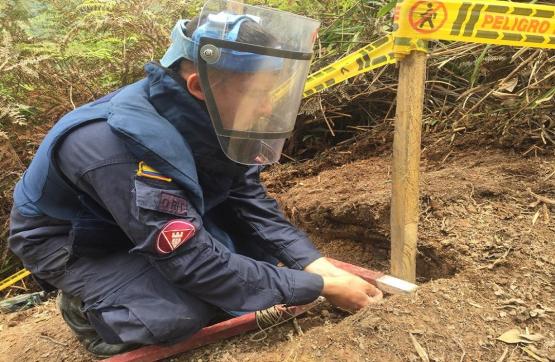
Arrived in 2015, this company is located in Nilo Cundinamarca exactly in the facilities of the School of Professional Soldiers with the intention of training personnel of Officers, Non-Commissioned Officers and soldiers in the area of humanitarian demining explicitly in the courses of Basic Demining, Demining Leaders and National Demining Supervisors thus achieving to train 2. 646 students who would initially integrate the Humanitarian Demining Engineer Battalions (BIDES) BIDES 1, BIDES2, BIDES3 and BIDES4; who would later integrate the Humanitarian Demining Engineer Brigade, which was created on August 6, 2016 in commemoration of the 197th anniversary of the National Army.
During 2016, the military transformation process was strengthened within the Force, supported by the doctrinal and conceptual leap that allows it to anticipate challenges, challenges and threats related to the security and defense of the nation. This continuous and dynamic process guarantees the fulfillment of the constitutional mission in accordance with the roles and challenges generated by the changes in the strategic environment, thus visualizing the creation of a Training Center based on its consolidated capabilities with the experience of the armed conflict, and at the same time allowing the National Army to be an example in the region. Proof of this was the exchange of instructors with Spain that allowed in October 2016 to train 88 students between Officers and Non-Commissioned Officers in Training of Trainers for Explosive Ordnance Disposal Level 2 (EOD-2) for its acronym in English Explosive Ordnance Disposal.
This military effort is accompanied in parallel by a cooperation program between Colombia and the North Atlantic Treaty Organization (NATO) called Individual Partnership Cooperation Program (IPCP), which was developed with this multilateral organization. This program was developed with this multilateral organization, and was framed within the objectives of the National Defense and Security Policy; at the time, the Commander of the National Army and the Commander of the Army of the Future Transformation Command (COTEF) designated a select group of officers to develop a project based on their experience in training and international training to consolidate a training center or education center that would achieve an international certification that would allow it to have a national or multinational sponsorship such as the North Atlantic Council and recognized by NATO. The officers selected to develop this project were chosen for their language skills and knowledge in academic exchange with other armies on an intercontinental basis.
In this context, the National Army of Colombia understood the need to make the conceptual and structural leap, which demanded to have a unit with interoperable doctrine, friendly, modern, with international standards, aligned to the challenges for the Force of today and the vision of the future in a social state of law.
In 2017, the instructors of the aforementioned company were installed in a new facility within the Special Brigade of Engineers (BRING); in these facilities they began to receive visits of great relevance such as the Joint Improvised-Threat Defeat Organization (JIDO) of the U.S. Department of Defense (DoD) and the Joint Improvised-Threat Defeat Organization of the U. S. Department of Defense (JIDO); and the Joint Improvised-Threat Defeat Organization of the U. S. Department of Defense (DoD). S. Department of Defense); and the Federal Bureau of Investigation (FBI) of the U.S. Department of Justice, these agencies make technical visits to learn about the National Army's strengths in order to train its men in post-explosion analysis. During this same year, visits continued to be received such as the Japan International Cooperation Agency (JICA) and the Cambodian Mine Action Center CMAC interested in learning how the National Army conducted its training in military and humanitarian demining.
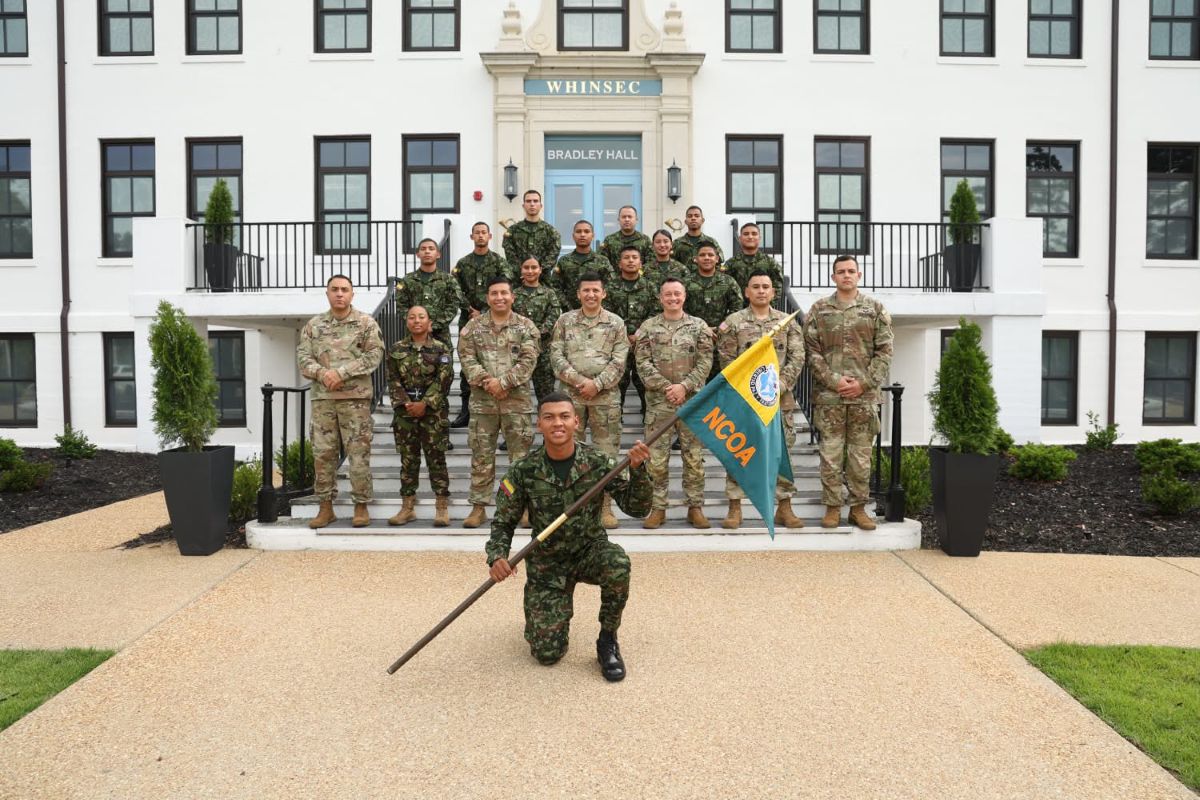
During 2018, from the COTEF, with the project already outlined, the strengthening of the concept of interoperability began, thus boosting the interest of other countries in our military capabilities. For this purpose, working tables were formed that showed that the training and training offered by this company of instructors should be articulated in the Army's education system, and due to its demining competencies, it would integrate a new section of the School of Engineers (ESING) called the International Demining Section, this section of the ESING during this year promoted significant exchanges and visits, such as receiving the visit of the Ambassador of the United States of America Kevin Whitaker and a staff of Commanders of the U.S. Army which make the delivery to the National Army of Colombia of a material for Humanitarian Demining.
The work carried out in 2018 allowed to materialize in the month of October a technical visit to Colombia led by a NATO delegation led by Dr. Frédérique Jacquemin Senior Program Officer of the Alliance Training and Education Centers (PTEC); in this visit a team of multifunctional experts attended to evaluate the suitability and possible inclusion of that demining training unit in the Community of Training and Education Centers of the Alliance. During this visit, the integration of efforts made it possible to present a strengthened training section to the NATO delegation. As a result, on March 15, 2019, the North Atlantic Council officially accepted the Colombian International Demining Center into the NATO Alliance Training and Education Centers (PTEC) network.
This recognition made CIDES the 33rd center in the world and the first and to date the only one in Latin America.